After servicing thousands of HVAC systems across Osceola County, we've observed a consistent pattern: homes with neglected air conditioning units are significantly more likely to develop mold problems—particularly during Kissimmee's humid summer months when outdoor moisture levels regularly exceed 70%. Your AC does more than cool your home; it's your primary dehumidification system, and when components like evaporator coils, drain lines, and air filters fall into disrepair, that moisture stays trapped indoors where mold thrives.
This guide shares what we've learned from real-world service calls about preventing mold through targeted HVAC maintenance in Kissimmee, including the specific trouble spots Kissimmee homeowners should monitor and the seasonal timing that makes the biggest difference in our subtropical climate.
TL;DR Quick Answers
HVAC Maintenance in Kissimmee
Kissimmee's subtropical climate puts unique demands on your HVAC system. Here's what local homeowners need to know:
When to schedule: Twice yearly—early spring before humidity peaks and early fall after summer strain.
Why it matters here: Your AC removes gallons of moisture daily. Neglected systems become mold incubators in our climate.
Key maintenance tasks:
Condensate drain line flushing
Evaporator coil cleaning
Duct leak inspection
Refrigerant level checks
Local resources:
License verification: myfloridalicense.com
KUA rebates: 407-933-9800
Warning signs to watch:
Indoor humidity above 55%
Musty odors from vents
Unit running constantly without dehumidifying
Bottom line: In Kissimmee, HVAC maintenance isn't just about comfort—it's your primary defense against mold. Schedule service before problems start, not after.
Top Takeaways
Uneven temperatures signal maintenance issues, not equipment failure. Most comfort complaints trace back to restricted airflow, duct leaks, or refrigerant decline. Targeted maintenance resolves these at a fraction of replacement cost.
Kissimmee's climate demands more frequent attention. Your system runs 2,500+ hours annually—triple the national average. Filters clog faster. Coils collect more buildup. Duct connections loosen sooner.
Duct leaks waste 20–30% of your conditioned air. Summer attic temperatures exceed 140°F. Unsealed ducts dump cooled air into that space instead of your rooms—creating hot spots and inflating energy bills.
Proactive maintenance costs less than reactive repairs. Monthly filter changes, annual tune-ups, and prompt attention to comfort changes prevent compounding efficiency losses and emergency calls.
Timing matters. Schedule comprehensive maintenance in early spring. Check filters monthly through summer. Address duct repairs in late fall when cooler attics allow safer work.
Why Routine HVAC Maintenance Prevents Mold in Kissimmee Homes
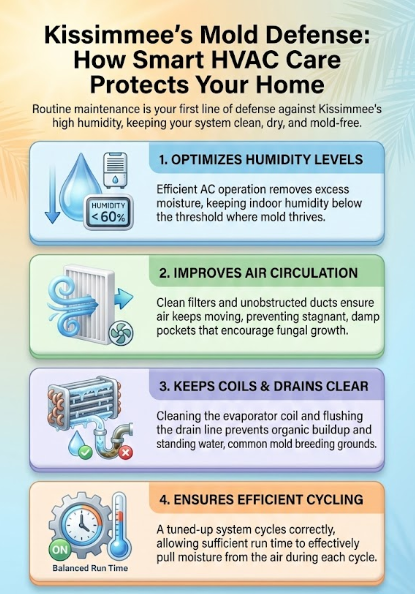
Your air conditioner functions as your home's primary dehumidifier—warm air passes over cold evaporator coils, moisture condenses into liquid, and that water drains away through your condensate line. When this system operates properly, indoor humidity stays between 30-50%, well below the levels mold needs to grow. However, clogged drain lines, dirty coils, and restricted airflow from neglected filters disrupt this process, trapping moisture indoors where Kissimmee's warm temperatures accelerate mold development within days.
The maintenance tasks that matter most for mold prevention target these moisture-control components directly. Flushing condensate lines prevents the backups that lead to standing water in drain pans and ductwork. Cleaning evaporator coils removes biofilm buildup where mold colonies establish themselves. Replacing filters every 30-60 days during peak cooling season maintains the consistent airflow your system needs to dehumidify effectively. Scheduling this maintenance in early spring—before humidity intensifies in May—gives your system the best protection through Kissimmee's most demanding months.
Warning signs that your HVAC system isn't controlling moisture include musty odors from supply vents, visible condensation around your indoor unit, and thermostat humidity readings consistently above 55%. Addressing these indicators promptly keeps minor maintenance issues from becoming costly mold remediation projects.
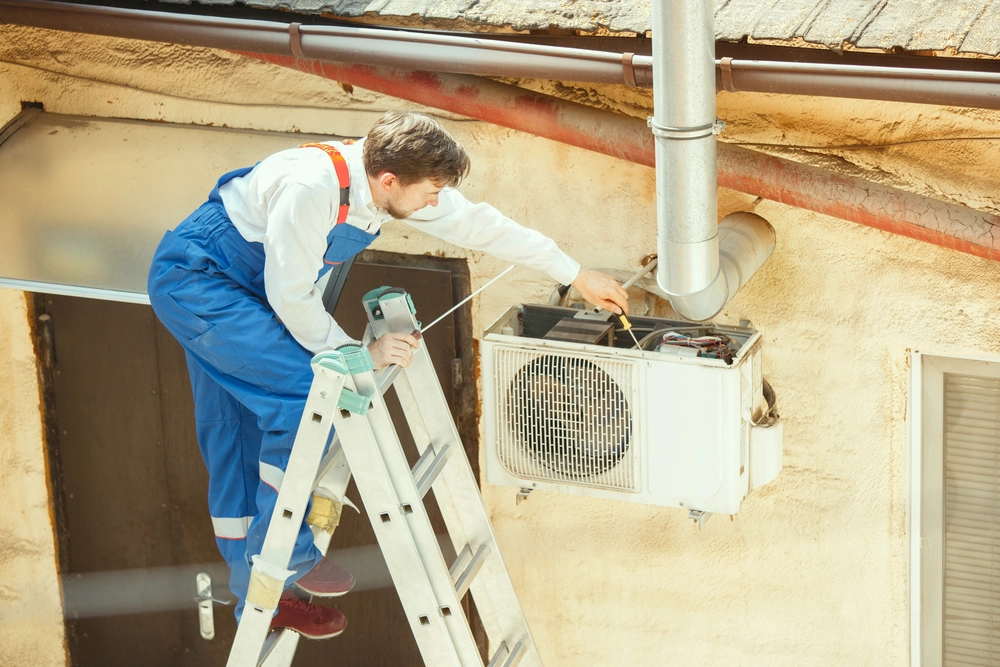
"In our experience servicing Kissimmee homes, the majority of mold issues we encounter trace back to a single overlooked component—the condensate drain line. A two-minute flush every few months prevents problems that cost homeowners thousands to remediate."
Essential Resources for Kissimmee Homeowners
Protect your investment and make informed HVAC maintenance decisions with these vetted resources from government agencies, local utilities, and consumer protection organizations.
Verify Your Contractor's License Before Signing Any Agreement
Florida law requires all HVAC contractors to hold a valid state license through the Department of Business and Professional Regulation. Search by company name or license number to confirm active status, check insurance coverage, and review any disciplinary actions or complaints filed against the contractor.
https://www.myfloridalicense.com/
Claim KUA Rebates to Offset Your Maintenance Costs
Kissimmee Utility Authority customers qualify for rebates on duct leak repairs, heat pump replacements, and energy-efficient system upgrades. Schedule a required in-home energy audit through the KUA Greenteam at 407-933-9800 to determine which rebates apply to your property.
https://kua.com/energy-conservation/rebates/
Understand the EPA Standards for Mold and Moisture Control
The Environmental Protection Agency recommends maintaining indoor humidity between 30-50% to prevent mold growth—a threshold your HVAC system directly controls. This guide explains proper condensate drainage, warning signs of moisture problems, and when professional remediation becomes necessary.
https://www.epa.gov/mold/brief-guide-mold-moisture-and-your-home
Follow the Energy Star Maintenance Checklist for Maximum Efficiency
Annual professional maintenance following Energy Star guidelines can improve system efficiency by up to 15% and prevent costly breakdowns. This checklist covers coil cleaning, refrigerant level checks, blower adjustments, and filter replacement schedules recommended by the EPA.
https://www.energystar.gov/saveathome/heating-cooling/maintenance-checklist
Review Florida Department of Health Guidance on Indoor Air Quality
Florida's subtropical climate creates unique mold risks that general HVAC guidance may not address. The state health department provides region-specific recommendations, county health department contacts for consultations, and information on when mold exposure may require medical attention.
https://www.floridahealth.gov/environmental-health/mold/index.html
Research Contractor Reputation Through the Better Business Bureau
Check BBB ratings, read verified customer reviews, and review complaint histories before hiring any HVAC company. Look for BBB-accredited contractors serving Osceola County with A+ ratings and resolved complaint records demonstrating accountability.
Find All Available Rebates With the Energy Star Rebate Finder
Enter your Kissimmee zip code to discover federal tax credits, state incentives, and local utility rebates you may be missing. Combining multiple rebate programs can significantly reduce the cost of HVAC upgrades and efficiency improvements.
https://www.energystar.gov/rebate-finder
Supporting Statistics
These findings from federal agencies align with patterns we consistently observe when servicing HVAC systems across Osceola County.
Indoor Humidity and Mold Growth Threshold
The U.S. Environmental Protection Agency recommends keeping indoor relative humidity below 60%—ideally between 30% and 50%—to prevent mold growth. We see firsthand how quickly Kissimmee homes exceed this threshold when AC systems aren't removing moisture effectively:
Outdoor humidity regularly climbs above 80% during summer months
A neglected evaporator coil or clogged condensate line can push indoor levels into the danger zone within hours
Mold can establish on wet surfaces within 24 to 48 hours once humidity rises
https://www.epa.gov/mold/mold-course-chapter-2
HVAC System Impact on Home Energy Use
According to the U.S. Department of Energy, heating and cooling represents approximately 35% of all building energy consumption—the largest share of any single end use. What this statistic doesn't capture is the hidden cost we observe in undermaintained systems:
Units running continuously yet failing to dehumidify adequately
Higher utility bills combined with persistent moisture problems
Overworked compressors struggling against Kissimmee's relentless humidity
Duct Leakage and System Efficiency Loss
Energy Star reports that approximately 20% of conditioned air in a typical home is lost through duct leaks, holes, and poor connections. In Florida's climate, this problem compounds:
Leaks pull hot, humid attic air into the system
Unconditioned air works against your AC's dehumidification efforts
We've traced numerous local mold problems back to undetected ductwork issues
https://www.energystar.gov/saveathome/heating-cooling/duct-sealing/benefits
Final Thought
Kissimmee's subtropical climate demands more from your HVAC system than simply cooling your home. Every day, your air conditioner extracts gallons of moisture from indoor air—a function most homeowners never consider until problems emerge.
After years of servicing homes across Osceola County, we've reached a straightforward conclusion: the majority of residential mold problems we encounter are preventable maintenance failures. The usual culprits include:
Clogged condensate drain lines
Dirty evaporator coils reducing dehumidification capacity
Leaky ductwork pulling humid attic air into the system
Address these issues proactively and you eliminate the moisture source before mold develops.
The homeowners who rarely deal with mold share one common habit: they schedule maintenance before peak humidity season arrives. Optimal timing looks like this:
Spring service (March–April) — Clear biological growth from drain lines, restore coil efficiency, and verify humidity control before daily demands intensify
Fall service (September–October) — Catch wear from months of continuous operation and prepare for mild heating season
Our recommendation is simple: Treat your HVAC system as your primary mold prevention tool, not just your cooling system. Consider the cost comparison:
Twice-yearly maintenance: approximately $300 per year
Single mold remediation project: often $3,000 or more
In a climate where outdoor humidity works against you six months of the year, proactive maintenance isn't optional—it's essential.
FAQ on “HVAC Maintenance in Kissimmee”
Q: How often should I schedule HVAC maintenance in Kissimmee?
A: We recommend twice yearly:
Early spring (March–April) — Before humidity intensifies
Early fall (September–October) — After months of continuous summer operation
In our experience, homeowners who follow this schedule rarely encounter mold issues or unexpected breakdowns.
Q: What does a typical HVAC maintenance visit include?
A: A comprehensive visit covers:
Condensate drain line flushing
Evaporator and condenser coil cleaning
Refrigerant level checks
Air filter replacement
Blower component inspection
Thermostat calibration
When servicing Kissimmee homes, we pay particular attention to drain lines and coils. These components account for the majority of mold-related service calls we receive.
Q: How do I verify an HVAC contractor is licensed in Florida?
A: Search the Florida DBPR database at myfloridalicense.com. You can confirm:
Active license status
Insurance coverage
Complaints or disciplinary actions
We always encourage verification before signing any agreement. Unfortunately, we've seen the damage caused by unlicensed work—voided warranties and failed inspections.
Q: Are there rebates available for HVAC maintenance or upgrades in Kissimmee?
A: Yes. Many homeowners don't realize they qualify. Kissimmee Utility Authority offers rebates for:
Duct leak repairs
Heat pump replacements
Energy-efficient system upgrades
Q: Why does my Kissimmee home feel humid even when the AC is running?
A: This is one of the most common complaints we hear. Typical causes include:
Dirty evaporator coils reducing moisture removal
Clogged condensate lines
Oversized equipment cycling off before adequately dehumidifying
Duct leaks pulling humid attic air into the system
Dirty evaporator coils reducing moisture removal
Clogged condensate lines
Oversized equipment cycling off before adequately dehumidifying
Duct leaks pulling humid attic air into the system
Here is the nearest branch location serving the North Palm Beach FL area…
Filterbuy HVAC Solutions - West Palm Beach FL
1655 Palm Beach Lakes Blvd ste 1005, West Palm Beach, FL 33401, United States
(561) 448-3760
https://maps.app.goo.gl/BP8p8pLU5n7w5nnFA